






Wiki Loves Africa’s 2026 theme once again revealed the extraordinary stories that unfold when community, creativity, and purpose come together to document the continent’s collective diversity. This year’s theme “Rites & Rituals” invited contributors to record the the festivals, from the religious to ancient communal traditions and practices, the rhythms of the everyday and coming-of-age milestones marked by families and communities that bring meaning to the human journey, shaping how we welcome new life, honour those who pass, celebrate commitments and achievements, and strengthen the bonds that hold communities together.
This year’s Wiki Loves Africa International Video Prize Winners zoomed in on the profoundly collective rites and rituals that shape societies across the continent.
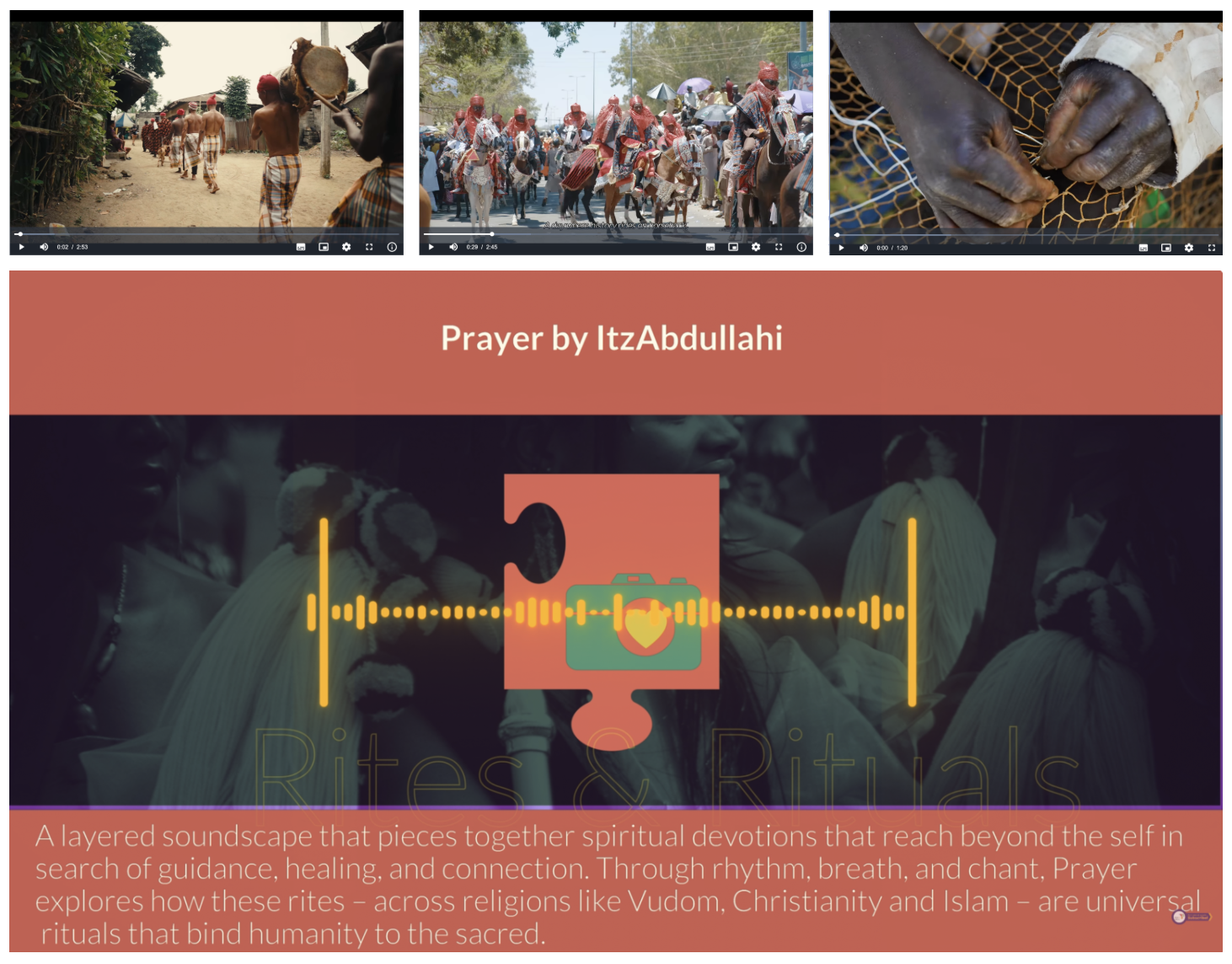
While the top photography prizes were awarded to personal expressions of the theme, both the video and audio juries looked towards entries that captured the collective for their winning submissions. For the last few years, the International Winners have been announced at Wikimania, the annual Wikimedia conference. However, this year, the video jury took longer to come to a consensus, only announcing their winners mid-August, two weeks after the conference ended. Jurors noted the professionalism of the entries, which resulted in longer shortlists in all categories, extending the final rounds of deliberation. Ultimately, engaging storytelling won Patterns of Obedience and Hawan Bariki the Reportage and Narrative video prizes. Similarly, immersion from every angle brought Argungu International Fishing Festival boldly to life, earning it the 2026 Clip video prize, while immersion of a different kind, this time through the layered sounds of workshop, won Prayer by Abdullahi T. Abubakar this year’s Audio prize.
Video Prize Winners
There are three distinct prizes in the Video category for best Narrative video, best Reportage video, and best Clip video.
Narrative Video Prize: Hawan Bariki by Sulaiman Yahuza (Nigeria)
Narrative Video Prize goes to Hawan Bariki by Sulaiman Yahuza (Nigeria) CC BY-SA 4.0, via Wikimedia Commons.
Winner of the Narrative Video Prize, Sulaiman Yahuza’s Hawan Bariki takes viewers into the spectacle and significance of the Bauchi Sallah Durbar, an annual celebration held during Eid in which traditional rulers and horsemen, dressed in elaborate ceremonial attire, gather to pay homage to the Emir — a ruler, prince, commander, or military governor in various Islamic countries. Through sweeping processions, traditional equestrian regalia, music and movement, Yahuza captures both the grandeur of the occasion and the community participating in it. The jury praised the film’s exceptional visual quality, rich colour, purposeful camera movement and rhythmic editing, which combine to immerse viewers in an event they may never have the opportunity to witness themselves.
“Encyclopedically, it provides invaluable, high-resolution visual context for articles covering African royal courts, equestrian traditions, and festive civic rites.” — Muhammed Amine Benloulou, International Jury
For Yahuza, however, the Durbar is much more than a colourful spectacle. The Rites & Rituals theme prompted him to look beyond the horses, clothing and ceremony to the meaning of the activities themselves and their role in sustaining history, traditional leadership and community identity. He came to see the Durbar as a living tradition: one that brings together traditional rulers, communities and the Emir in an expression of respect, unity and heritage passed down through generations. His aim was to narrate the experience in a way that would allow someone who had never witnessed the Durbar to understand not only its beauty, but its cultural significance.
That ability to carry a deeply local tradition far beyond Bauchi State, Nigeria, is also what Yahuza values about Wiki Loves Africa. Contributing to the project has encouraged him to document African stories from his own perspective and given him an opportunity to share his community’s culture with a global audience. “A Durbar in Bauchi may be a familiar tradition to us, but documenting it allows someone thousands of kilometres away to see, learn about and appreciate it,” he says. In doing so, he believes African visual storytellers can both preserve their heritage and broaden the global understanding of a continent rich in distinct histories, traditions and communities.
Reportage Video Prize: Pattern of Obedience by Israel Joshua Uzochi (Nigeria)
Reportage Video Winner: Pattern of Obedience by Israel Joshua Uzochi (Nigeria), CC BY-SA 4.0, via Wikimedia Commons.
Winner of the Reportage Video Prize, Israel Joshua Uzochi’s Pattern of Obedience uses the language of documentary reportage to explore culture and tradition through imagery, visual metaphor and community interviews. Carefully constructed yet grounded in observed experience, the film allows its subjects and surroundings to carry the narrative rather than relying on extensive explanation. The jury praised its concise and coherent storytelling, cinematography, framing, colour grading and editing, as well as Uzochi’s ability to communicate a complex cultural story in a form that remains immediately accessible to the viewer.
“The filmmaker uses only imagery, visual metaphor and community interviews to tell a complex and rich story, but one that is easy to follow and understand its significance.” — Rachel Zadok, International Jury
For Uzochi, the film grew from a desire to preserve a genuine moment that might otherwise have gone unnoticed. Rather than staging what he encountered, he sought to document the emotion, culture and resilience unfolding naturally around him. The Rites & Rituals theme encouraged him to approach this process with greater patience and sensitivity, looking beyond visually striking scenes to moments that revealed belief, tradition and human connection while respecting the dignity of the people whose lives and practices he was documenting.
Contributing to Wiki Loves Africa has also changed the way Uzochi approaches visual storytelling. He describes becoming more intentional about documenting the people, places, cultures and everyday experiences around him, recognising that an individual image or film can become part of a much larger open visual record. For him, enabling Africans to document their own lives and communities is also a means of challenging reductive narratives about the continent and showing “the diversity, beauty, resilience, and richness of who we are as Africans”.
Clip Video Prize: Argungu International Fishing Festival by Mohammed Alamin (Nigeria)
Video clips are short (maximum of 1 minute) uncut or simple shots that visually show a process or how something is done. Often they are part of footage from a longer video. A clip could be raw footage, a time-lapse, or a single take. For use of clips on Wikipedia, a clip should show the subject of the article in motion. They can include ambient sound of what is being illustrated, where the sound effect illustrates part of the process or what is being explained or illustrated. A clip can also be without sound, music or audio effects.
The Clip Video Prize goes to Argungu International Fishing Festival by Mohammed Alamin (Nigeria), CC BY-SA 4.0, via Wikimedia Commons.
Winner of the Clip Video Prize, Mohammed Alamin’s Argungu International Fishing Festival plunges the viewer into the energy, movement and competition of one of Nigeria’s great cultural festivals. Using shifts in speed, dynamic camera angles, fluid transitions and tightly paced editing, Alamin captures both the scale of the gathering and the momentum of the fishing competition itself. Despite its short format, the clip tells a complete story, moving through the event with a clear sense of chronology while placing the viewer amid the crowds and action. The jury praised its professional editing and cinematic storytelling, particularly the way its varied perspectives create a sense of urgency and immersion.
“This video exemplifies strong cinematic storytelling, capturing the collective energy and cultural significance of the Argungu Fishing Festival.” — Muhammed Amine Benloulou, International Jury
Alamin describes his approach simply: he documented the festival from his own perspective, seeking to recreate what someone present at the scene might experience. The Rites & Rituals theme encouraged him to observe what was happening around him more closely, while the clip format allowed him to distil those observations into a fast-moving visual experience. The result captures not only the excitement of the competition, but a communal tradition in action, bringing together participants and spectators in a celebration of cultural identity.
Contributing to Wiki Loves Africa has made Alamin more deliberate about what he chooses to showcase through his work. He also sees the project’s value in something equally straightforward but fundamental: presenting the continent to the world from the perspective of Africans themselves. Through works such as Argungu International Fishing Festival, familiar experiences and traditions can become part of an open visual record of Africa, documented by the people experiencing them.
Audio Prize Winner: Prayer by Abdullahi T. Abubakar (Nigeria)
Soundscapes, audio stories or audio recordings can be an evocative way to tell a story without images. The power of audio is that the visuals are created by the imagination of the listener.
The Audio Prize goes to Prayer by Abdullahi T. Abubakar, Wikimedia Commons, CC BY SA 4.0.
Winner of the Audio Prize, Abdullahi T. Abubakar’s Prayer explores one of the most universal of human rituals through sound. Bringing together the Christian The Lord’s Prayer, the Muslim call to prayer and traditional Vodun chants, the piece moves through distinct spiritual soundscapes while revealing something shared beneath them. Voices, rhythms, repetition, pauses and silence become the means through which different expressions of faith are experienced, creating a work that celebrates the diversity of African spiritual traditions while exploring the common human desire for guidance, protection, healing and connection with the sacred.
“Outstanding. Great production. Great message.” — Isla Haddow-Flood, International Jury
For Abubakar, audio was fundamental to telling this particular story. “Prayer is not only something we see; it is something we hear and feel,” he explains. A call to prayer, a congregation reciting together or a traditional chant can immediately evoke a particular place, community and ritual. The Rites & Rituals theme encouraged him to listen more closely to the ways faith and tradition become audible, shifting his attention from what rituals look like to the sounds, emotions and meanings carried through prayer, chanting, rhythm, repetition and silence.
Creating also pushed Abubakar beyond his usual photographic practice and strengthened his interest in sound as a means of preserving memory, identity and cultural practice. Through Wiki Loves Africa, he has begun to think of his work not simply as something created for an immediate audience or publication, but as part of a shared cultural archive. “When Africans contribute photographs, videos and sounds to an open knowledge platform like Wikipedia, we are not simply telling stories for an audience—we are helping build the archive through which future generations and the rest of the world will understand who we are,” he says.
That archive, Abubakar argues, can also help expand the narratives through which Africa is understood. By documenting spirituality, celebrations, languages, creativity, communities and everyday life from within the continent, African contributors can create a record that reflects its complexity rather than reducing it to a single story. Prayer embodies that idea through sound: distinct voices and traditions existing alongside one another, different but connected, carrying their histories forward.
Many thanks to the panel of jurors (read more about them here), and congratulations to the winners. #WikiLovesAfrica