







Missed the launch of Wiki Loves Africa 2026? Here’s everything you need to know!
Now in its 12th year, Wiki Loves Africa continues to invite people across the continent to document and share the richness, creativity, and diversity of African life. Through photographs, video, and audio, the annual contest captures everyday realities — and makes them freely accessible to the world via Wikimedia Commons.
Since its launch in 2014, the competition has grown into a vibrant, continent-wide movement. More than 12,800 contributors have shared over 146,000 media files, helping to illustrate thousands of Wikipedia articles with authentic, locally rooted perspectives.
But Wiki Loves Africa is more than numbers. It is a community-driven celebration — a space where people tell their own stories, preserve cultural knowledge, and contribute to a shared, open record of Africa in all its complexity and beauty.This year’s theme, Rites & Rituals, turns the spotlight toward the moments that shape our lives — from birth to burial, celebration to remembrance, and everything in between.
Why Rites & Rituals?

Image attribution: File:Hair_Stylist.jpg by SAgbley, CC BY-SA 4.0, via Wikimedia Commons

Rites and rituals are woven into every aspect of life across Africa (and globally wherever humanity thrives). They shape how we welcome new life, honour those who pass, celebrate milestones, and strengthen the bonds that hold communities together.
They are both deeply personal and profoundly collective.
A ritual might be as intimate as braiding hair, brewing tea, or exchanging greetings — or as expansive as a harvest festival, religious ceremony, or public celebration. Some practices are rooted in centuries-old traditions. Others are continuously reimagined, adapted, or newly created in response to contemporary life — think evolving street culture, like hand gestures to hail taxis.
Together, they connect past, present, and future — carrying memory, meaning, and identity across generations.
Sacred, shared, celebrated

File: Homestead Ritual.jpg by Nate Chituti, CC BY-SA 4.0, via Wikimedia Commons

For Wiki Loves Africa 2026, contributors are invited to explore and document rituals in all their forms, including:
- Rites of passage: naming ceremonies, coming-of-age rituals, marriages, funerals
- Religious practices: prayer, pilgrimages, festivals, offerings
- Cultural expressions: dance, masquerades, storytelling, crafts
- Everyday rituals: protective braids, breaking fasts, daily hygiene practices like cleaning teeth, greetings, hand signals to hail taxis, communal life
- Civic rituals: national days, parades, flag-raising ceremonies
- Creative gatherings: music festivals, theatre, visual arts, craft traditions
From the smallest daily gestures to the grandest communal celebrations, these moments offer a powerful way to document Africa’s living heritage.
💡 Upskill with Wiki Loves Africa
If you’re looking to sharpen your skills, join one of the Wiki Loves Africa Masterclass workshops: they’re free! The 2026 series of online sessions is designed to support contributors at every level. Whether you’re new to Wikimedia Commons or want to improve your photo, audio, or storytelling approach, these sessions offer practical guidance, tips, and space to ask questions. If the skillset you’re looking for isn’t part of our 2026 sessions, you can access the recordings from past trainings and webinars to learn at your own pace.
🔗 Explore upcoming sessions and recordings on Meta
🔗For previous years’ masterclasses, search Meta for Category:Wiki Loves Africa Trainings.
The International Prizes
| Photography Prizes | Media Prizes |
| 1st Prize: USD 900 | Narrative Video: USD 900 |
| 2nd Prize: USD 700 | Reportage Video: USD 900 |
| 3rd Prize: USD 600 | Clip Video: USD 200 |
| Wilson Oluoha Prize: USD 1,000 | Audio: USD 700 |
| Photo Essay: USD 300 |
Wiki Loves Africa celebrates a wide range of media contributions that support encyclopaedic knowledge. Prizes are awarded across photography, audio, and video — recognising media that clearly documents subjects, processes, and practices in ways that are useful for Wikimedia projects, and contribute to open knowledge. Whether you’re capturing a defining moment, recording the sounds of a ceremony, or documenting a ritual step by step, there are multiple ways for your work to be recognised and rewarded.
Multiple media prizes, from long-form video prizes, an audio prize, and a photo essay prize, allow contributors to go beyond the single snapshot and document a sequence of moments that together provide a deeper understanding of the subject. Instead of capturing a single instant, a photo essay can follow a ritual in its entirety : the preparation, the anticipation, the gathering, the key moments, and what comes after. A reportage video can add to the encyclopedic canon by factually documenting how a cultural practice unfolds and delving into why the tradition exists, while a narrative video can tell more personal stories centred around family. These might be the careful steps before a wedding ceremony, the rhythm of a communal meal being prepared, or the unfolding of a spiritual or cultural practice over time. Each contributes to a clearer picture of the subject — showing not only what happens, but how it unfolds and why these traditions evolved.
Rites & Rituals is underway
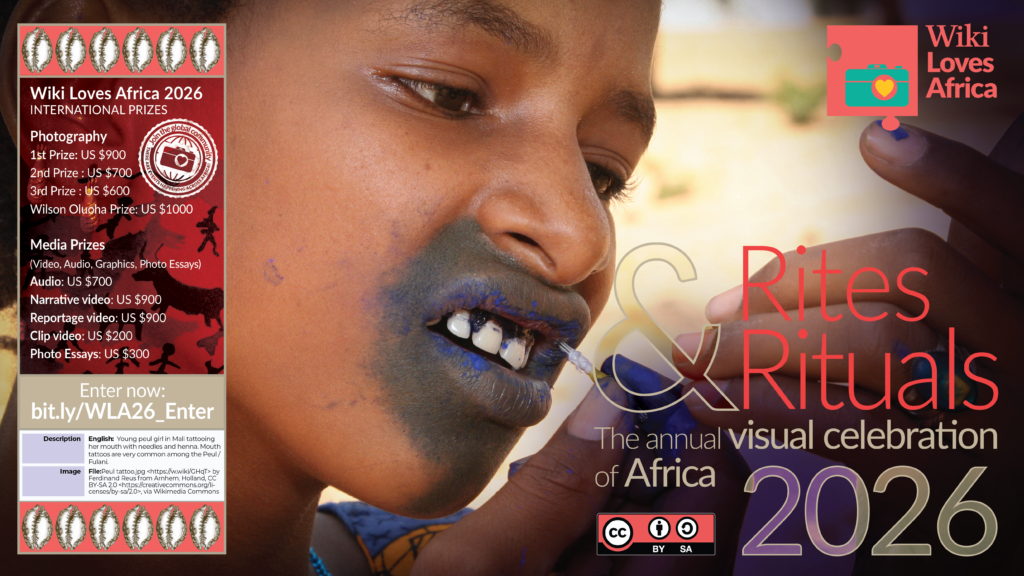
Wiki Loves Africa 2026 is officially underway — and across the continent, contributors are already beginning to document the traditions, stories, and symbols that shape African life.
This year’s theme, Rites and Rituals, opens up a rich and expansive field of storytelling. From deeply personal moments to large-scale communal gatherings, participants are capturing the practices that define identity, memory, and belonging — in both everyday life and extraordinary moments.Whether you’ve been following from the start or are only joining now, there is still plenty of time to take part, share your perspective, and contribute to a growing, open archive of African knowledge. Contest closes 30 April
🔗 Join in!
Document the rituals, moments, and meanings that matter in your community.
- Wiki Loves Africa 2026 Rites & Rituals theme page.
- Wiki Loves Africa on Wikimedia Commons
- Wiki Loves Africa 2026 Rites & Rituals Organisers Hub on Meta
Wiki Loves Africa on Meta